



Long before the world watched Hilda Effiong Bassey stir pots through four sleepless days and nights, she was a child learning how hard it is to keep a food business alive. Her mother was a cook who moved Hilda and her brother from Calabar to Abuja in search of a better life, working an office job while selling food on the side to her co-workers. Later, the family’s income rested on a food kiosk, and Hilda has recalled helping out after school, serving customers and making small talk, even as the kiosk was demolished many times, leaving her mother weighed down by stress and anxiety. It is tempting to assume that a girl raised in this case would love cooking but Hilda has been candid that this was not the case. She did not enjoy cooking with her mother, and her interest only began around the age of eight, when a pot of spaghetti she made for an aunt in Calabar earned her so much praise that she wanted more of that kind of attention.
After studying sociology at Madonna University in Okija, Hilda spent her early adult years chasing several versions of success, a restlessness she has acknowledged herself, since she has said she was pursuing other things before she committed to cooking professionally. She worked in television, co-hosting the MTN music reality project Y’ello Star in 2020, and she also set her sights on reality television. She has revealed that she auditioned for Big Brother Naija about four or five times and was rejected each time, hoping the show would make her famous enough to launch the cook-a-thon she already had in mind. She also approached Guinness World Records about a cooking marathon in 2018 but was told to wait because the record had just been broken.
While she waited, she worked, and it was in those ordinary, unglamorous jobs that her real training took place. In her final year at university, her brother brought her a business plan for a food service in which customers would subscribe to meals the way people subscribe to TV channels, and that idea became “My Food”. Her very first customer was her mother, who paid ₦15,000 for the subscription. In 2019, she took a job on a breakfast company’s team, where, by her own account, she cooked every day for about 200 people, and eventually she rose to manage the company’s lunch division, which gave her experience running a culinary business.
The real turning point came in 2020, just as the world shut down. In February of that year she started MyFoodbyHilda from a tiny apartment in Ikate, preparing food in bowls for clients during the lockdown and slowly growing her customers online and offline. Even while she was building something from almost nothing, she was giving back, and during the pandemic she provided more than 3,000 meals to underprivileged communities. Yet the work she was putting in was not enough to earn her respect in a competitive industry, because as a young, unmarried woman she met skepticism about whether she could make it in the food business. Being underestimated became part of the daily grind, and it pushed her to prove herself, so she kept building until people had to take her seriously. Fortunately, the wins began to add up, with a victory at the Jollof Faceoff competition in Ghana in 2021 and the launch of her first fast-food restaurant in June 2022.
By the time the cook-a-thon began on May 11, 2023, it was the product of years of waiting, rejection and hard work. Before the event, she began physical training and studied people who had attempted similar feats, and in the run-up to the event she tested herself with a 24-hour trial run. She cooked for six hours at a stretch and rested for only thirty minutes, and she cut down on how much water she drank so she would not have to step away from the stove. She also worked with a nutritionist to adjust her diet around the demands of the marathon, knowing the rules would give her only five minutes of rest for every completed hour.
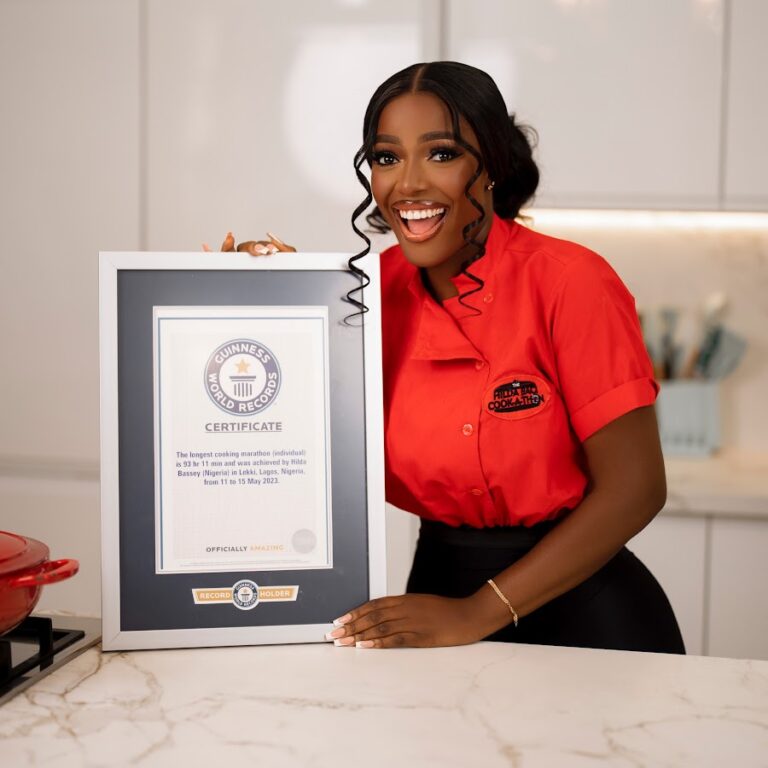
None of that preparation made the four days at Amore Gardens in Lekki any easier, because even after two years of training she still had to fight through physical exhaustion and cramps that never left her. The cramps were made worse by the fact that she was on her period the entire time, which cut into the little rest she was allowed and left her father worried about how severe her cramps can get. Her body gave her trouble from the start, and the first day proved the hardest of all, with her body failing her so many times that she nearly gave up a couple of times. By the 67th hour, the strain was plain for everyone watching, since the coverage recorded tears, swollen feet, fatigue and vomiting, along with a support system that stayed by her side. It was that support, together with her own refusal to stop, that carried her to the end, by which point she had prepared about 100 pots of food. Her effort was rewarded when Guinness World Records certified her time at 93 hours and 11 minutes, surpassing the 87 hours and 45 minutes set by Indian chef Lata Tondon in 2019. She has said that she took on the challenge to put Nigerian cuisine on the map and to inspire young African women to chase their dreams, and in the end she did more than that, because the woman who once waited for a reality show to make her famous had become famous through her own work, with a pot, a plan and years of patience behind her.
