


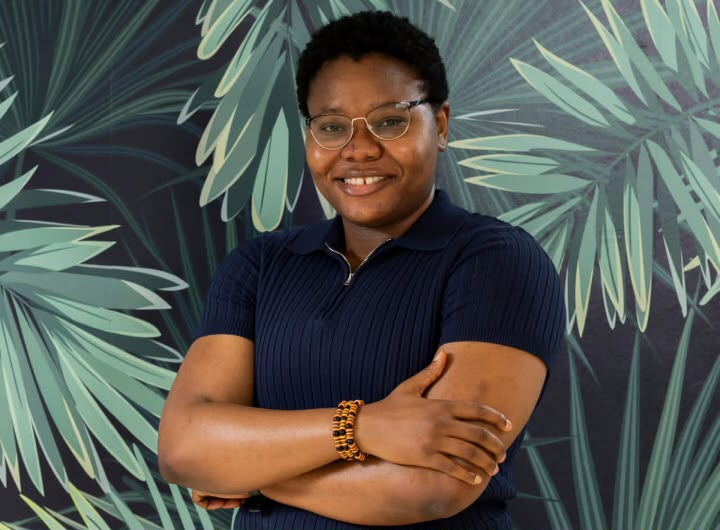
When the Nigeria Prize for Science and Innovation announced its 2026 winner in Lagos this week, it did more than hand out the country’s most valuable science award. It changed who gets to imagine themselves winning it.
Mary-Brenda Akoda became the first woman, and the first millennial, to win the prize as an individual recipient in its twenty-two-year history, taking home the one hundred thousand dollar award for GenScan AI, an artificial intelligence tool that could reshape how Nigerians access medical imaging.
Her winning innovation, formally known as GenScan AI or GenMRI/C-MORE, uses a one step consistency model to reconstruct MRI images, cutting scan times by as much as ninety percent without requiring new hardware.
For a healthcare system where MRI machines are scarce and appointments can mean months of waiting, that kind of efficiency does not just save time. It expands who can actually get scanned in the first place, particularly in the resource constrained hospitals judges specifically pointed to when explaining their decision.
Akoda’s win came from a record field. The 2026 edition drew 237 entries, the highest number the prize has received since it began, and arrived a year after the competition recorded no winner at all in 2025.
Against that backdrop, the panel, chaired by Professor Barth Nnaji, described its decision as unanimous, noting that Akoda’s work consistently scored highest among judges evaluating scientific innovation, technical depth, developmental impact, and how realistically it could scale.
Her path to this moment reads like a case study in what focused, sustained investment in a young woman’s education can produce. Akoda graduated with first class honours in Computer Science from Goldsmiths, University of London, before completing a Master of Research with Distinction in Artificial Intelligence and Machine Learning at Imperial College London, where she held a Google DeepMind Scholarship.
She went on to work as a software engineer and AI research scientist at Microsoft, including time at its Mixed Reality and AI Research Lab in Cambridge, before turning her attention to a problem much closer to home.
What makes her win matter beyond the prize money is what it signals about who Nigeria’s science and innovation sector considers capable of leading it.
In twenty two years and twelve previously recognized winning works, no woman had claimed the individual prize on her own before Akoda. That absence was never proof that Nigerian women were not doing the science. It mostly reflected how narrow the path to recognition had been.
NLNG has said it is actively working to widen that path, taking the prize beyond the judging room and engaging directly with researchers, universities, and the media to grow participation, a push that helped produce this year’s record entry pool.
For Akoda personally, the win brings a six figure award, a public platform at the Grand Award Night on October 9, and the kind of institutional credibility that tends to unlock further funding, research partnerships, and healthcare adoption for GenScan AI.
For the women coming up behind her in Nigerian STEM and AI research, it brings something arguably more valuable: proof, on the record, that the country’s top science prize is not out of reach.
