


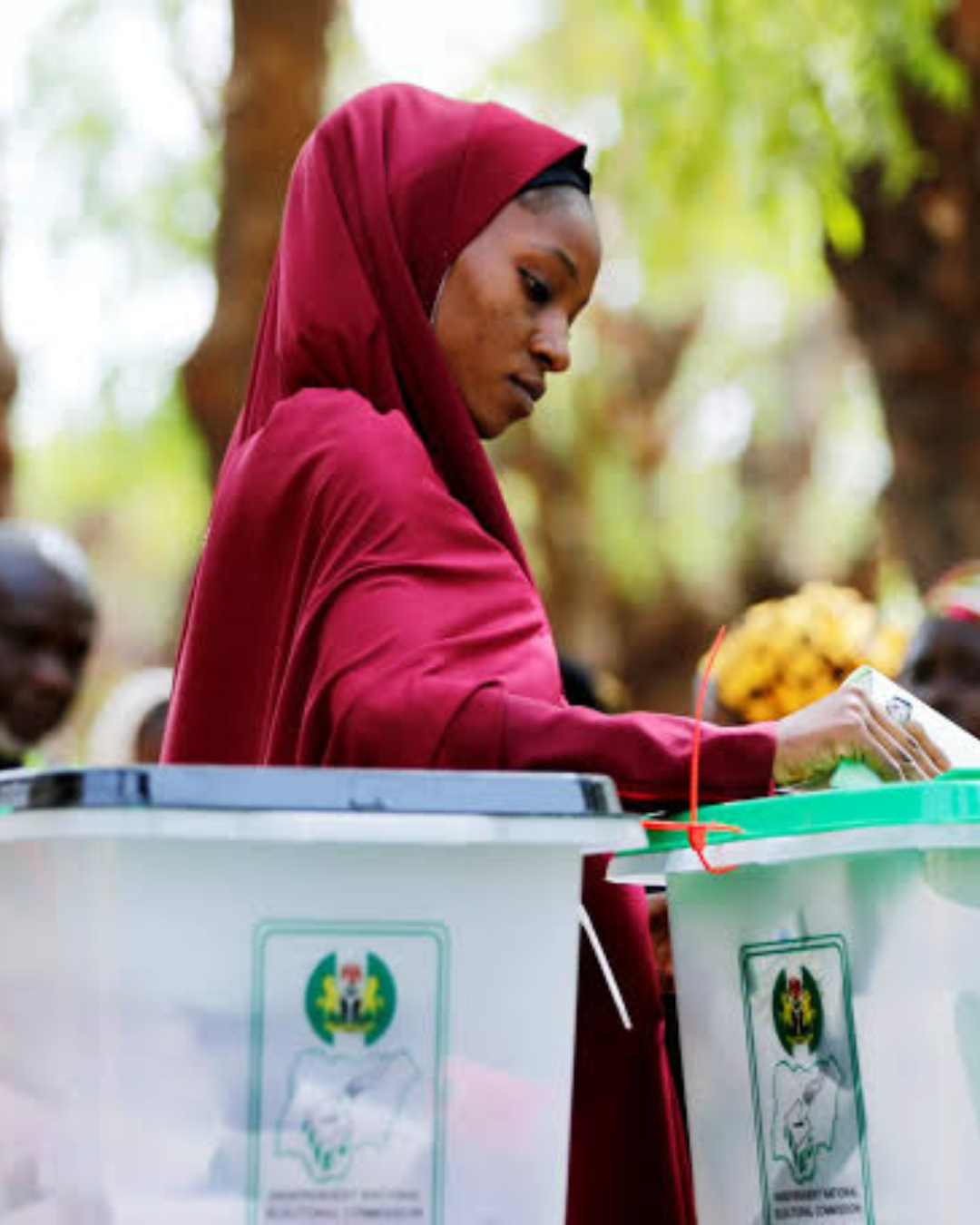
Women accounted for 52.68 per cent of new voter registrations in the latest CVR phase, but remain severely underrepresented among candidates and elected officials ahead of the 2027 elections.
Nigerian women are participating in elections in significant numbers, but their presence in the electorate continues to contrast sharply with their representation among political candidates and elected officials, according to new figures from the Independent National Electoral Commission (INEC).
Women accounted for 2,037,589, or 52.68 per cent, of the 3,867,997 Nigerians registered during the third phase of the 2026 Continuous Voter Registration exercise as of July 26, according to the commission.
The figure is broadly consistent with women’s participation in the 2023 electoral register, when women accounted for 47.52 per cent, or 44,414,846, of Nigeria’s 93,469,008 registered voters. But that numerical presence has not translated into comparable representation on the ballot or in elected office.
In the 2023 elections, only 1,556 of 15,331 candidates across major elective positions were women, representing 10.15 per cent of candidates. After the elections, women held just three of the Senate’s seats, or 2.8 per cent, and 16 seats in the House of Representatives, or 4.4 per cent.
The disparity was highlighted by INEC at a strategic engagement in Abuja with political party leaders, female candidates, civil society organisations and development partners.
Representing INEC Chairman Prof. Joash Amupitan, National Commissioner Prof. Rhoda Gumus said the gap between women’s participation as voters and their representation in leadership remained a challenge for Nigerian democracy.
“A democracy that mobilizes women as voters but provides limited pathways for them to become political leaders is yet to fully realize its representative potential.”
Gumus described women’s inclusion in political leadership as a democratic imperative and called for political parties to move beyond commitments to inclusion and implement measures that can increase women’s representation.
The latest registration figures complicate the idea that women’s political exclusion is primarily a question of voter participation. Women are registering to vote in substantial numbers. The sharper gap appears further along the political process: who gets nominated, who can afford to contest, who can campaign safely and who ultimately wins elected office.
INEC Secretary Dr Rose Oriaran-Anthony, represented by the Director of Gender and Inclusivity, Lakunuya Dorothy Bello, said the commission could not address the disparity alone.
Political parties play a central role because their internal processes determine who receives party tickets and, in many cases, who gets the opportunity to contest on a viable platform. This places part of the responsibility for improving women’s representation outside the polling unit and within the political parties themselves. For Nigerian women seeking elective office, participation can involve barriers that extend beyond the formal requirements for contesting an election.
Speaking at the engagement, former INEC Director and former Attorney General of Edo State Oluwole Osaze-Uzi identified legal, cultural, financial and security barriers as factors limiting women’s political participation. The financial burden of seeking a party ticket and running a competitive campaign can make political participation difficult, while intimidation and harassment can create additional risks for women who enter the political space.
Osaze-Uzi recommended measures including internal party quotas, dedicated campaign funding for female candidates and a zero-tolerance approach to intimidation and sexual harassment. These interventions matter because encouraging more women to participate as voters does not, by itself, address the structural barriers that can prevent them from becoming candidates.
Nigeria’s low level of women’s political representation also stands out against developments elsewhere on the continent. 41 of Africa’s 54 countries have adopted some form of gender quota, citing countries including Rwanda, Senegal, Namibia, South Africa, Mozambique and Cape Verde.
Rwanda provides the most significant contrast. Women’s representation in its parliament rose from less than five per cent in 1994 to nearly 64 per cent, following the adoption of measures designed to increase women’s political representation. Nigeria, by comparison, has never elected a woman as President or Governor and women continue to occupy only a small proportion of seats in the National Assembly.
The comparison demonstrates that political representation can change when electoral and party structures deliberately create pathways for women to enter political office.
Political representation determines who participates directly in shaping legislation, budgets, public services and policies that affect everyday life. For women, this can include decisions concerning healthcare, education, economic opportunity, social protection, security and other areas that shape their ability to participate fully in society.
The significance of representation lies partly in ensuring that women are present in the institutions where these decisions are debated and made. That makes the gap between women’s participation as voters and their presence in elected office particularly significant ahead of 2027.
INEC’s latest figures show that Nigerian women are already a substantial part of the country’s electoral base.
The more difficult question is whether political parties and the wider political system will create meaningful pathways for that participation to extend beyond voting.
The challenge is not simply getting more women to participate in democracy. It is determining what stands between women’s participation at the polling unit and their representation in political power—and whether Nigeria’s political institutions are prepared to address it.
