


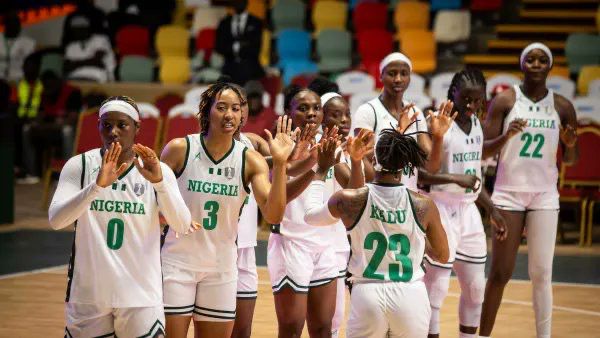
The long-awaited payment of the $100,000 reward promised to each member of Nigeria’s D’Tigress has been welcomed by the team’s captain, Amy Okonkwo, and Nigeria Basketball Federation President Musa Kida, with both describing the development as an important step forward for athlete welfare and sports administration in Nigeria.
The payment, confirmed on September 11, 2026, followed President Bola Ahmed Tinubu’s pledge to reward the team after it won the 2025 FIBA Women’s AfroBasket in Abidjan, Ivory Coast. Each player has now received the naira equivalent of $100,000, while team officials received the equivalent of $50,000.
The financial reward completes part of a wider package announced by Tinubu after D’Tigress defeated Mali 78–64 in the final to claim their fifth consecutive AfroBasket title and seventh continental championship.
The package also included three-bedroom homes in Abuja and national honours, which Okonkwo said the team had also received.
Kida expressed satisfaction with the disbursement and thanked National Sports Commission Chairman Mallam Shehu Dikko and Director-General Bukola Olopade for their role in completing the administrative process.
He also commended Minister of Finance and Coordinating Minister of the Economy, Prof. Taiwo Oyedele, for helping to expedite the release of the approved funds. Kida described the development as a positive boost for Nigerian basketball and reiterated the federation’s support for D’Tigress.
For Okonkwo, the payment represents the completion of the commitments made to the team after their AfroBasket triumph. She thanked the president and described the development as an “unprecedented gesture”, noting that the team had received the houses, national honours and financial rewards promised following their victory.
“On behalf of the entire D’Tigress team, I want to specially thank our dear President, Bola Ahmed Tinubu, GCFR, for this show of love and support,” she said.
She also thanked the First Lady, the leadership of the National Sports Commission and the Nigeria Basketball Federation for their roles in the process.
For D’Tigress, the payment is significant not simply because of the size of the reward, but because it converts a promise made after a major sporting achievement into tangible financial support. When governments and sports bodies make financial commitments to athletes, the eventual fulfilment of those promises can shape how athletes view the systems supporting them.
Winning medals and bringing international recognition to the country can generate enormous public celebration, but the economic value of women’s sporting achievements is often less visible. The payment to D’Tigress therefore raises a broader question about what it means to properly reward women who represent Nigeria at the highest level.
The conversation around women’s sport in Nigeria frequently centres on visibility — television coverage, sponsorship, facilities, media attention and larger audiences. But visibility without economic value has limits.
When women athletes are properly compensated, sporting success becomes more than a source of national pride. It becomes evidence that sport can provide a viable professional pathway.
D’Tigress has already demonstrated that Nigerian women can build sustained excellence in elite sport. Their latest AfroBasket title was their fifth consecutive championship, extending Nigeria’s unbeaten run in the competition to 29 games.
The financial recognition attached to that achievement adds another dimension to the story. It says that the women producing those results have economic value — and that their success should be recognised accordingly.
Women’s sport needs structures that allow athletes to build sustainable careers rather than depend on exceptional rewards after major international victories. Women athletes should not have to win a continental championship before their economic contribution becomes visible.
The payment to D’Tigress should therefore be viewed as part of a larger conversation about how Nigeria supports the women who represent it. Seeing women rewarded for excellence can help change that perception. But the long-term goal should be bigger than one payment.
Nigeria needs systems that make athlete welfare predictable rather than exceptional: transparent reward structures, timely payments, investment in grassroots sport, stronger domestic leagues, professional development and opportunities for women to build careers both during and after competition.
It needs to build a sporting system in which those champions are valued, supported and paid
