


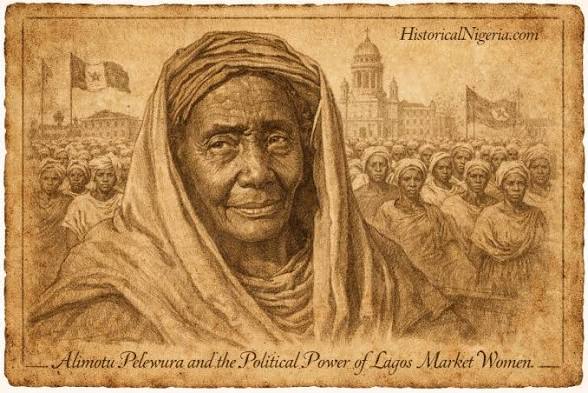
Alimotu Pelewura was a fish trader and one of the most prominent market women in colonial Lagos. For her, the marketplace was more than a place to trade. It became a place from which she built influence.
Pelewura spent decades organising women around the economic and political issues affecting their lives. As leader of the Lagos Market Women Association, she mobilised thousands of women against colonial policies involving taxation, food prices, markets and trade.
Her career did not follow the conventional path into political leadership. She did not begin in government or hold elected office. Her influence grew from the marketplace, from her work as a trader and from her ability to organise other women around shared interests.
Pelewura’s story is therefore not only about one woman who challenged colonial rule. It is also about how economic communities can become political communities.
From the Fish Trade to Leadership
Pelewura was born in Lagos and followed her mother into the fish trade. She eventually established herself as a fish seller and became a leader among the city’s market women.
By the 1920s, she was chairwoman of Araromi Market and had become increasingly involved in organising women traders. She later emerged as the leader of the Lagos Market Women Association, an organisation that gave market women a collective platform for addressing issues affecting their livelihoods.
At a time when formal political institutions largely excluded women, the marketplace offered another form of influence.
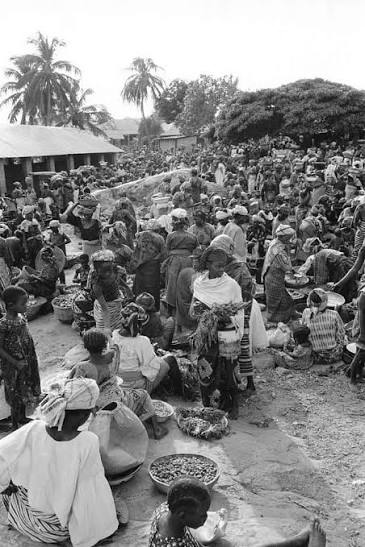
Market women were economically important to Lagos. They sold food and other goods, supported households and maintained networks that connected different parts of the city. Pelewura understood that this economic position could also give women collective bargaining power. She began turning that understanding into action.
Then She Turned Organisation Into Political Power
Pelewura worked alongside nationalist politician Herbert Macaulay and became involved in the Nigerian National Democratic Party’s political activities. Under her leadership, the Lagos Market Women Association reportedly grew to thousands of members.
But her activism was not simply about party politics. Much of it was rooted in the immediate economic concerns of the women she represented.
When colonial authorities proposed an income tax that would affect women earning above a certain threshold, Pelewura organised against it. In December 1940, she led market women in a protest and petitioned the colonial authorities over the proposed tax.
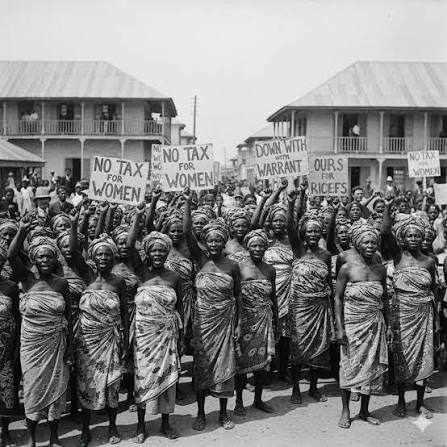
The campaign contributed to a change in the proposed threshold, which was raised from £50 to £100. The episode demonstrated something that would become central to Pelewura’s political influence: organised women could put pressure on authorities even when they were excluded from formal political institutions. Their power was in their numbers, their economic importance and their ability to act collectively.
When the Market Became a Political Space
Pelewura’s activism extended beyond taxation. She became involved in protests over colonial policies affecting food prices and the livelihoods of traders. During the 1945 general strike, she supported striking workers and encouraged market women to provide goods on credit.
Her leadership reflected a broader understanding of what political issues looked like for working women. For market women, government policy was not an abstract conversation happening somewhere in a colonial office. It could determine how much they paid, what they could sell, where they could trade and whether their businesses remained viable.
The market therefore became a political space. Pelewura’s leadership connected the everyday concerns of women traders to wider struggles over colonial economic control and Nigerian self-determination.
Building Influence Without a Formal Political Office
One of the most striking things about Pelewura’s career is that her influence did not depend on holding formal political office. She built authority through her community.
Her position as a market leader gave her access to a large network of women, while her ability to organise that network made her an important figure in Lagos politics. This was particularly significant in a period when Nigerian women were largely excluded from formal political participation.
Pelewura demonstrated that political influence could also be built through associations, markets, petitions, protests and collective economic action. Her story complicates the idea that political leadership always begins with a title. Sometimes, it begins with people willing to organise around a shared interest.
A Legacy That Outlived Her
Pelewura died in 1951, but the political and social institution she helped strengthen continued after her.
The position of Iyaloja, traditionally associated with leadership among market women, remained an important institution in Lagos, while Pelewura’s name was later attached to Pelewura Market on Lagos Island.
Her legacy is therefore both physical and political. There is the market that carries her name. There is the institution of market leadership. And there is the example of a woman who demonstrated that economic organisation could become a form of political power.
