


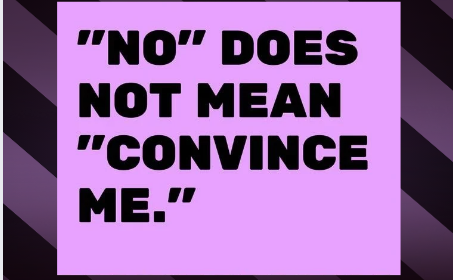
Consent is one of the most misunderstood topics in relationships, yet it remains one of the most essential. Many young women grew up without proper education on what consent truly means and because of this gap, several harmful myths have continued to spread. These myths include the idea that silence means agreement, that what a person wears is an invitation for unwanted touch, or that being in a relationship removes the need to ask for consent.
To gain a clearer understanding, it is important to look beyond what consent is and examine what it is not:
1. Consent is not implied by silence. Clear and enthusiastic agreement is required for any intimate act. As such, when a person freezes, remains quiet, or does not resist, that response should never be interpreted as permission. In many cases, that reaction is a sign of fear, confusion, or discomfort.
2. Consent is not automatic in dating or marriage. In the same way, being someone’s girlfriend, fiancee, or wife does not grant automatic permission for intimacy. Instead, every act requires a fresh and mutual agreement, regardless of relationship status, and this principle is also recognized by law. In Lagos State for instance, forcing a wife to have sex after she has refused can be prosecuted as sexual assault by penetration under Sections 259 and 263 of the Criminal Law of Lagos State, which carries a punishment of life imprisonment. This means that even within marriage, consent must be freely given, and it can be withdrawn at any time.
3. Consent is not valid when a person is intoxicated, asleep, or under pressure. This is because an individual who is drunk, high, unconscious, or being threatened or manipulated cannot provide genuine consent. Therefore, any agreement that results from fear, guilt, or coercion is not freely given.
4. Consent is not determined by clothing. In other words, an outfit, regardless of how short, tight, or revealing it may appear, is never an invitation for unwanted touch. For this reason, clothing should never be used as justification for crossing boundaries.
5. Consent is not a one-time decision that lasts forever. While agreeing to something in the past may seem like ongoing permission, it does not mean that agreement is permanent. Similarly, consent to one act does not translate to consent for all acts. Every person retains the right to change their mind at any moment, and that decision must be respected immediately.
6. Consent is not present when agreement is given out of fear or guilt. Ultimately, for consent to be real, it must be given freely, without manipulation or the fear of negative consequences.
Understanding what consent is and is not helps build a culture where boundaries are respected and personal rights are upheld. When consent is clearly understood, relationships become safer, communication becomes stronger, and respect remains the foundation for all interactions.
