


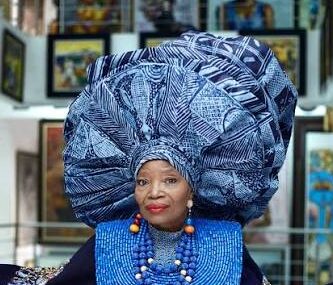
Before Nike Davies-Okundaye became the woman behind one of Nigeria’s best-known art institutions, she was a little girl learning how to work a loom.
There was no gallery yet, no five-storey building in Lagos, and no international exhibitions or university lectures. There was simply a child growing up around people who knew how to weave, dye, embroider and make things with their hands.
Born in 1951 in Ogidi-Ijumu, present-day Kogi State, Nike grew up in a family where craft was part of everyday life. Her great-grandmother taught her weaving and adire, while her father passed on skills in embroidery and beadwork. Nike began weaving when she was six. By the time she was ten, she was already considered highly skilled at the loom.
Her education was not taking place in a classroom. It was happening through observation, repetition and practice, the way much traditional craft knowledge had been passed from one generation to another.
That education became particularly important after Nike lost her mother at six and her grandmother the following year. She was subsequently raised by her great-grandmother and other relatives, continuing to learn the crafts around her.
It would eventually become the foundation for almost everything she built.
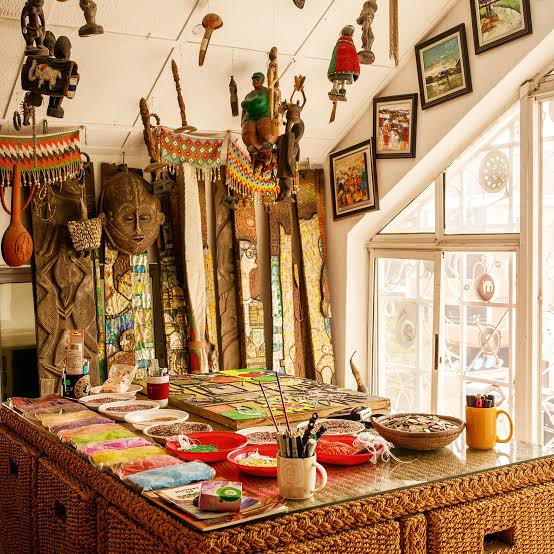
Adire, the Yoruba resist-dyeing tradition she learnt, was more than decorated cloth. It involved knowledge of dyes, patterns, symbols, materials and techniques passed down through generations. Nike was learning it from inside the tradition rather than studying it from a distance. That gave her an understanding of textiles not just as objects, but as a way of recording stories, identity and everyday life.
As a teenager, her life eventually took her to Osogbo, a city that was becoming an important centre of Nigeria’s modern art movement. There, she encountered artists, workshops, performances and a community experimenting with ways of bringing Yoruba culture and traditional knowledge into contemporary art. Nike became part of that environment and apprenticed with artists including Susanne Wenger. She also worked with Twins Seven-Seven. Her practice began to expand beyond what she had learnt at home.
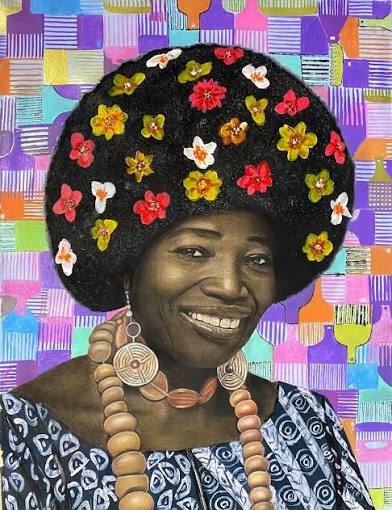
Nike did not simply inherit traditional textile-making and preserve it exactly as she had found it. She experimented with it. She worked across adire, batik, embroidery, weaving and appliqué, and began introducing figures and images into her textiles.
She later explained that when she started putting figures and images into her designs, local buyers did not initially take to them, while foreign visitors did. She would explain the stories behind the imagery in Yoruba because, at the time, she could not speak English. The detail is revealing because it shows her learning something beyond the craft itself: how to communicate the value and meaning of what she was making.
One of the stories associated with her experimentation with batik began with an accident. Melted candle wax fell onto a textile she was working on. Instead of treating the mark as a ruined piece of fabric, she experimented with what the wax had done to the material. The mistake became another technique to explore.
She was also exhibiting surprisingly early. In 1968, at just 17, she held her first solo exhibition at the Goethe-Institut in Lagos. Nike had no formal art-school education. Her training had come largely through apprenticeship, observation and practice. Yet by her late teens, the work she had learnt to make as a child was already being exhibited.
In 1974, she was one of ten African artists selected to travel to the United States to teach traditional arts and crafts. She conducted workshops and lectures across the country, introducing audiences to Nigerian textile traditions while also encountering a different way of presenting and teaching art.
Nike has said that the artists were encouraged to bring something back that would benefit their people. She had seen galleries, museums and craft institutions abroad, and began thinking about what it would mean to create spaces where Nigerian artists could learn, work and find an audience at home.
Those questions eventually moved Nike’s work beyond art and into entrepreneurship.
In 1983, she established the Nike Centre for Art and Culture in Osogbo. It began with 20 girls taken from the streets, according to accounts of the centre’s early history. Nike provided them with accommodation and food while training them in arts and crafts, and the work they produced could be sold through her galleries.
The model was significant because the centre was not built around charging students for an art education. Her daughter, Seyi, later described a system in which students and young artists could train without paying and keep the money from works sold through the gallery.
The skill itself became the opportunity. Weaving could become income. Dyeing could become a profession. Embroidery could become a craft business. Art could become a way for someone to build a livelihood. Over time, the centre expanded beyond Osogbo. Nike established other creative spaces, including a textile weaving centre in Ogidi-Ijumu and centres in Abuja and Lagos.
Her work increasingly existed at the intersection of art, cultural preservation, education and enterprise. Then came the gallery that most Nigerians recognise today.
The Nike Art Gallery in Lagos grew into a five-storey space filled with thousands of works by Nigerian and African artists. It became more than a place to display Nike’s own work. It was an extension of the ecosystem she had been building for decades: a place where art could be exhibited, bought, taught and encountered.
By then, the loom that had once been part of her childhood had become something much larger. It had become a way of making art. A way of teaching. A way of preserving knowledge. A way of creating income. And eventually, a foundation for a cultural enterprise.
There is a tendency to talk about cultural preservation as though it means keeping the past untouched. Nike’s career tells a more complicated story. Sometimes preserving a tradition means giving it enough room to change, travel, create income and remain useful to another generation.\
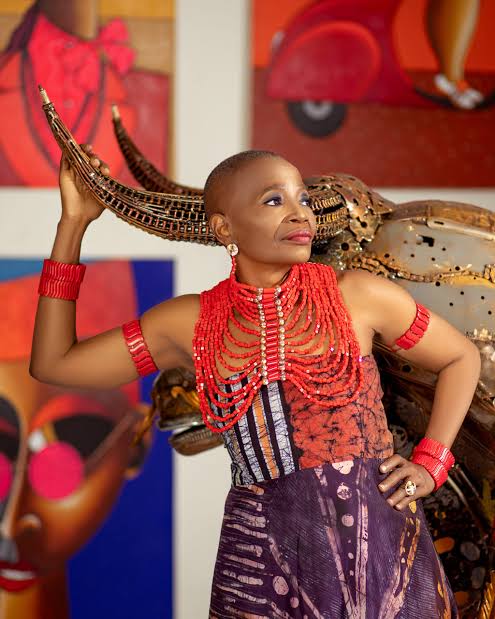
The loom was never just a loom. For Nike, it became an education before she had a conventional one, a livelihood before she had an enterprise, a passport to places she had never imagined visiting, and eventually the foundation of an institution much bigger than herself.
Before the art empire, there was the craft. Before the international recognition, there was a teenager exhibiting her work in Lagos. Before the gallery, there were the women who taught her how to weave. And before she became “Mama Nike,” there was simply Nike, a girl learning what could be made with her hands. She could not have known exactly what that knowledge would become.
But she kept working with it.
