


At a United Nations General Assembly side event in New York, Nigeria’s Minister of Women Affairs, Imaan Sulaiman-Ibrahim, made a case for changing how women’s economic empowerment is approached.
Women, she argued, should not only be beneficiaries of economic programmes. They should also be business owners, producers, innovators and decision-makers participating across the value chains that drive the economy.
Speaking at an event organised by Vivacity Development on the sidelines of UNGA 81, Sulaiman-Ibrahim called for stronger collaboration between government, businesses and development organisations to create pathways for women into technology, artificial intelligence, financial services, clean energy and other high-value sectors.
“We have to put heads together, the government and practitioners, to provide various pathways and entry points for women,” she said.
Using clean cooking as an example, the minister argued that women should not only benefit from access to cleaner cooking technology but should also be able to develop the skills to manufacture the technology, build businesses around it and access financing to participate in the sector.
The distinction is important.
Economic empowerment is often discussed in terms of how many women receive training, grants, loans or other forms of support. But another question is where women sit within the economy itself: Are they consumers and beneficiaries, or are they also creating businesses, controlling capital, building industries and making decisions?
Nigeria already has women operating at different points across that spectrum.
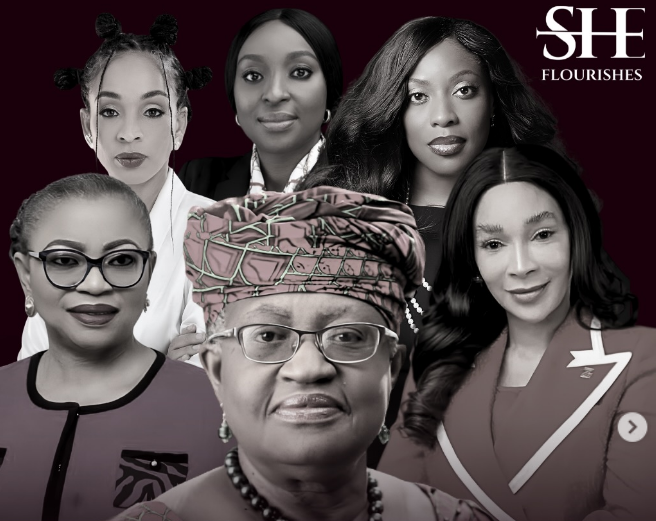
From global trade and banking to energy, media and agriculture, these women are influencing economic activity through the companies they lead, the capital they manage, the markets they build and the institutions they shape.
Ngozi Okonjo-Iweala: Shaping global trade
For Ngozi Okonjo-Iweala, economic influence happens at the level of institutions and international trade.
The economist and former Nigerian finance minister is the Director-General of the World Trade Organization, becoming the first woman and first African to hold the position.
The WTO plays a central role in international trade, making the position significant for countries such as Nigeria seeking to expand exports, attract investment and increase the value generated from their participation in global markets.
Okonjo-Iweala previously spent 25 years at the World Bank, where she became Managing Director of Operations. She also served twice as Nigeria’s finance minister and briefly as foreign minister. Her economic role therefore extends beyond running a single company. She operates within an institution that influences the rules and systems through which countries trade.
Folorunso Alakija: Building and owning businesses
Folorunso Alakija’s career illustrates another form of economic participation: ownership.
Her career began in office administration before she moved into banking and later established a fashion business. She eventually moved into the oil and gas sector and became Executive Vice Chairman of Famfa Oil.
Her business interests have extended across oil and gas, fashion, real estate and other sectors. Alakija’s story is relevant to the conversation about women as economic players because it moves beyond access to opportunities and into ownership.
Rather than participating only as an employee or beneficiary within an industry, she built and controlled businesses operating across sectors where significant economic value was generated.
Mo Abudu: Building the creative economy
Economic influence does not only happen in oil, banking or finance. Nigeria’s creative industries are also a significant part of its economy.
Mo Abudu has built her career around that space. As CEO of EbonyLife Media, Abudu leads a media company producing and distributing African-focused content for local and international audiences.
Her influence extends beyond the programmes and films audiences consume. Media companies create jobs for writers, producers, actors, directors, editors, designers and other creative professionals, while also developing intellectual property that can be distributed and monetised across markets.
Abudu has also invested in skills development through the EbonyLife Creative Academy, which was launched with the Lagos State Government to provide practical training in filmmaking and media production.
Her story shows how women can participate in the economy by creating businesses and platforms around industries such as entertainment, media and intellectual property.
Adaora Umeoji: Leading where capital moves
If women are to become economic players, access to capital is one part of the conversation. Another is who makes decisions about how that capital moves. Adaora Umeoji became the first woman to lead Zenith Bank as Group Managing Director and Chief Executive Officer in 2024, after decades in the financial services sector.
Her position places her at the head of one of Nigeria’s major financial institutions, where decisions around banking, investment, technology and financial services have implications for businesses and consumers.
Umeoji’s career also illustrates a different path to economic leadership. Rather than founding a company, she rose through an established institution and eventually reached its highest executive position.
Her story is a reminder that economic influence can also come from leading institutions through which individuals and businesses access financial services and capital.
Owen Omogiafo: Leading across major industries
Owen Omogiafo represents another route into economic influence: corporate leadership at scale. As President and CEO of Transcorp, she leads a diversified Nigerian conglomerate with interests including power and hospitality.
These sectors have direct connections to wider economic activity. Power affects businesses and households, while hospitality contributes to employment, tourism and investment.
Before becoming Transcorp’s CEO, Omogiafo built a career spanning organisational development, change management and strategic leadership. She has also participated in broader private-sector conversations around Nigeria’s economic development.
Her position demonstrates how women can influence the economy through the leadership of large companies and the strategic decisions made within them.
Ndidi Nwuneli: Building value across agriculture
Agriculture provides perhaps one of the clearest examples of why the value chain matters.
Ndidi Nwuneli has spent decades working across agriculture, food systems, entrepreneurship and development. She is co-founder of Sahel Consulting and AACE Foods and founder of LEAP Africa and African Food Changemakers.
Through Sahel Consulting, her work has included agricultural value chains, policy, market research, strategy and implementation. That means her work is not limited to food production itself. It extends to the systems around production: markets, businesses, policy, processing, entrepreneurship and investment.
Nwuneli’s career therefore reflects the kind of participation Sulaiman-Ibrahim highlighted at UNGA, where women are involved not simply as recipients of economic opportunities but in creating businesses, markets and solutions within an industry.
The bigger question is where women sit in the economy
These six women operate in very different sectors and have taken very different routes to leadership.
Okonjo-Iweala works at the level of global trade. Alakija built ownership across multiple industries. Abudu has built a media business around African storytelling. Umeoji leads a major financial institution. Omogiafo oversees a conglomerate with interests in power and hospitality, while Nwuneli works across agriculture and food systems.
Their stories are not interchangeable, but they demonstrate that being an economic player can take different forms. It can mean owning a business, managing capital, creating jobs, building infrastructure, developing intellectual property, shaping policy, creating markets or influencing the institutions through which businesses operate.
As artificial intelligence, financial technology, clean energy and other industries reshape the economy, the question may therefore be less about whether women are included and more about where they are positioned within the economy.
Are they only accessing the products and opportunities being created, or are they also building the companies, technologies, markets and systems creating them? For the women already operating in those spaces, the shift from beneficiary to economic player is not a future ambition. It is already happening.
